
Doris Salcedo
Guggenheim Museum, New York
June 26-October 12, 2015
There is no history without memory. Memory needs to be recalled, reshaped, and reconstituted. Doris Salcedo’s first major retrospective, organized by the Museum of Contemporary Art Chicago and showing at the Guggenheim Museum in New York, accomplishes exactly this. Five years in the making, this outstanding exhibition co-curated by Madeleine Grynsztejn and Julie Rodrigues Widholm, presents more than one hundred sculptures, installations, and a film on the artist’s public art works.
Doris Salcedo (b. 1958, Bogotá) has given form and voice to people who have suffered loss and experienced trauma and displacement. The thematic, structural, and material resolutions of her work beg close readings to appreciate the layers of meanings held within. From the late 1980s the artist’s points of reference have been the prolonged civil war and its adverse effects on the lives of millions of Colombians. In Salcedo’s discursive narrative, she chooses objects, like furniture, toys and clothing, over people to speak to pain, torture, (re)membering and, most of all, mourning.
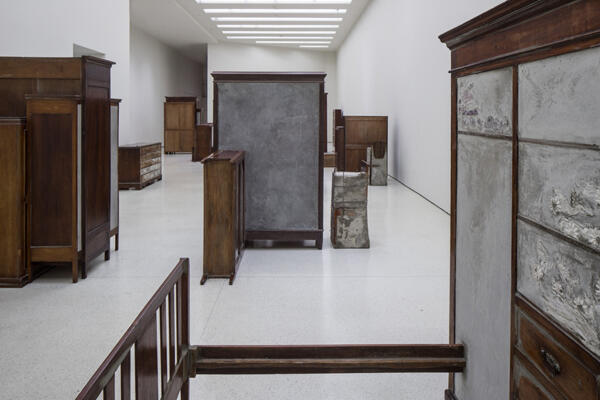
Salcedo applies an unusual material vocabulary together with an obsessive attention to the remaking of furniture that is alternately found, hand-constructed, or from victims. She alters headboards, mattresses, doorframes, beds, chairs, tables, desks, cribs, dressers, night tables by recombining parts. [Ill. #1 Installation view of furniture] Her use of soft and hard materials repurposed from domestic life creates disturbing physical and emotional juxtapositions. A small end table ( Untitled, 1990), now battered and damaged, occupies a special place in the gallery near larger pieces of recombined furniture, of which much is filled with concrete. The table has been dismantled and reconstructed so that a smaller steel table is inserted into the original wooden one. The two surfaces of concrete and wood combine with two different legs made of wood and steel. A series of wooden chairs ( Untitled, 1989, 1995, 2000, 2008), each filled with concrete, reassembled with steel, too heavy to move, are literal and metaphorical dead weights. The artist spent a month installing the works in the galleries of the four Guggenheim towers to assure a precise positioning of objects to objects and series to series according to size, form, and content. An air gravitas surrounds Plegaria Muda (2008-9), an installation composed of sculptural units formed from one table inverted on top of the other. [Ill. 2] Stand-ins for nameless coffins, the tables are attached [to each other] by an earth-like dark material (concrete). Walking slowly through the uneven rows, live blades of grass creep through cracks in the wooden surfaces referencing life and death, remembering and forgetting. “Being in a violent country, you cannot act as though violence is not happening.” (All quotes from film) Unland: irreversible witness (1995-98) features two wooden tables seamlessly joined at different levels with a small crib perched at the end of one of them. [Ill. 3] A fine silk, semi-transparent mesh covers the surfaces where strands of human hair and thread are painstakingly hand-woven through tiny holes. Upon close look, you feel that each thread represents a destroyed life, now recalled. These sculptures arise from Salcedo’s interactions with Colombian children who had witnessed their parents’ murders. I immediately recalled several iconic works by artists whose diverse mediums and aesthetic strategies address similar thematic objectives. Alfredo Jaar’s The Eyes of Gutete Emerita (1996) is a photographic image of the eyes of a woman who had watched her family killed in the Rwanda genocide. Oscar Muñoz’s works in which faces of people, appear and disappear, symbolically reminding us of the fugacity of life, the difficulty in remembering, or even visualizing the disappeared.
The film Doris Salcedo’s Public Works (2015) is a tour de force that reveals her deeply held concerns on war, life, death, loss, and grieving through the artistic enactments in the public domain. [Ill. 4] The artist, together with studio partners, curators, and directors discuss her meticulously laborious material and constructive processes required for ephemeral public projects. These include Untitled (2003) for the 8th International Istanbul Biennial where 1,150 wooden chairs were piled up to a determined height in an empty lot between two buildings surrounded by ones abandoned when Jews and Greeks were forcibly displaced from them many years ago.
Salcedo’s wrestling with the subject of refugees in Abyss (2005) is a defyingly difficult reconstruction of thousands of hand-made bricks in the artist’s studio that extend from the vaulted ceiling close to the floor in a gallery at the Castello de Rivoli Museo d’Arte Contemporanea in Turin for the T1 Triennial of Contemporary Art. The work was described as “a large anxiety-creating, heavy weight.” (Carolyn Christov-Bakargiev, Former Chief Curator) Noviembre 6 y 7 (2002) was a highly charged ephemeral site-specific action commemorating the seizure of the Palace of Justice in Bogotá in 1985 by the M-19 guerrilla group. During the battle to retake the palace, the Colombian army killed more than a hundred people including half of the Supreme Court judges. In resurrecting the memories of the atrocity, Salcedo’s action involved the slow lowering of 1,150 wooden chairs on ropes over the façade beginning at the time the original first forensic report announced the deaths of the victims and continued until the time the army violently ended the seizure. While passing the Palace during the two-day artistic action, people remembered victims who had died there. The public work foregrounds memory, acknowledges absence, reveals wounds, and creates a space for mourning. Characteristic of Salcedo’s work, this action “does not give answer to questions, only poses questions.” In that sense, perhaps, memory becomes history.
-
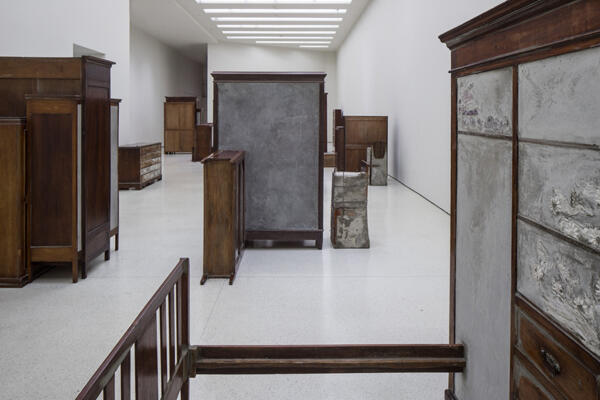 Series of furniture, 19892008. Installation view, Doris Salcedo, Solomon R. Guggenheim Museum, New York, June 26–October 12, 2015. Photo: David Heald © Solomon R. Guggenheim Foundation
Serie de muebles. Vista de la instalación, Doris Salcedo, Museo Solomon R. Guggenheim, Nueva York, Junio 26-Octubre 12, 2015. Foto: David Heald © Fundación Solomon R. Guggenheim
-
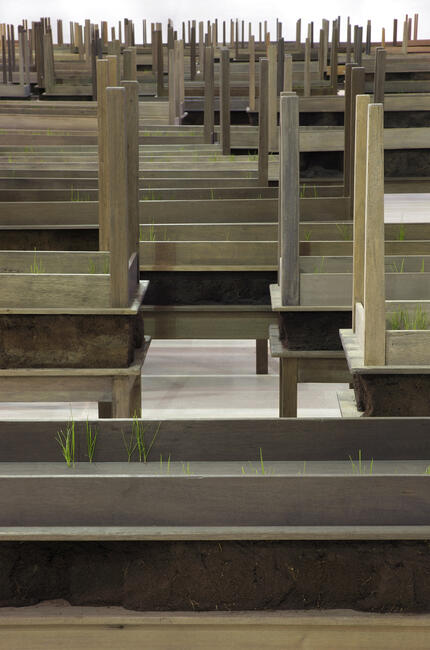 Plegaria Muda, 2008–10. Wood, concrete, earth, and grass. One hundred and sixty-six parts, each: 64-5/8 x 84-1/2 x 24 in. Overall dimensions variable. Installation view, CAM–Fundação Calouste Gulbenkian, Lisbon, 2011. Inhotim Collection, Brazil. Photo: Patrizia Tocci
Madera, concreto, tierra y pasto. Ciento sesenta y seis partes, cada una 164 x 214 x 61 cm. Dimensiones totales variables. Vista de la instalación, CAM–Fundación Calouste Gulbenkian, Lisboa, 2011. Colección Inhotim, Brasil. Foto: Patrizia Tocci
-
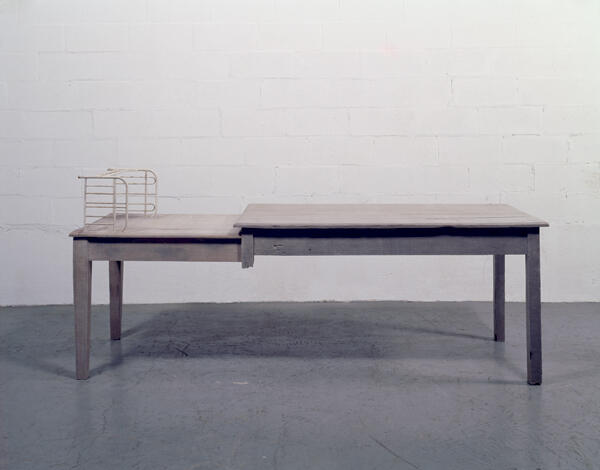 Unland: irreversible witness, 1995–98. Wooden tables, steel crib, silk, human hair, and thread, 44 x 98 x 35 in. San Francisco Museum of Modern Art, purchase through the Jacques and Natasha Gelman Fund and the Accessions Committee Fund. Photo: David Heald
Mesas de madera, cuna de acero, seda, cabello humano e hilo, 111,8 x 248,9 x 88,9 cm. Museo de Arte Moderno de San Francisco, adquirida a través del Fondo Jacques y Natasha Gelman y el Fondo del Comité de Adhesiones. Foto: David Heald
-
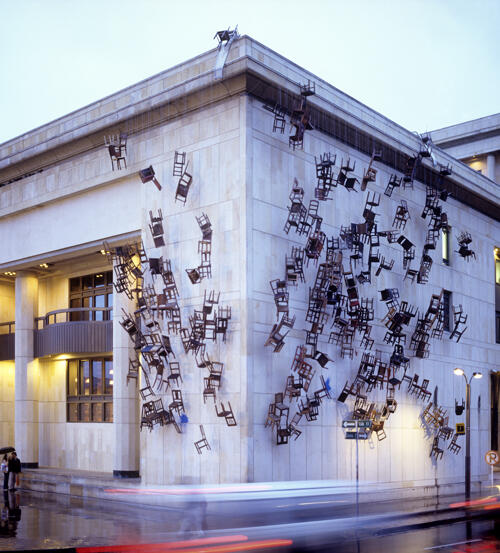 Noviembre 6 y 7, 2002. Two hundred and eighty wooden chairs and rope. Dimensions variable. Ephemeral public project, Palace of Justice, Bogotá, 2002. Photo: Sergio Clavijo.
Doscientas ochenta sillas de madera y soga. Dimensiones variables. Proyecto de arte público efímero, Palacio de Justicia, Bogotá, 2002. Foto: Sergio Clavijo