
Common Projects: Kaarina Kaikkonen’s _Traces” and “Dialogues_
The Finnish artist Kaarina Kaikkonen is presenting two exhibitions in two different venues in Santiago: “ Traces”, featured on one of the staircases of the Museum of Memory and Human Rights, and “Dialogues”, held in the National Museum of Fine Arts.
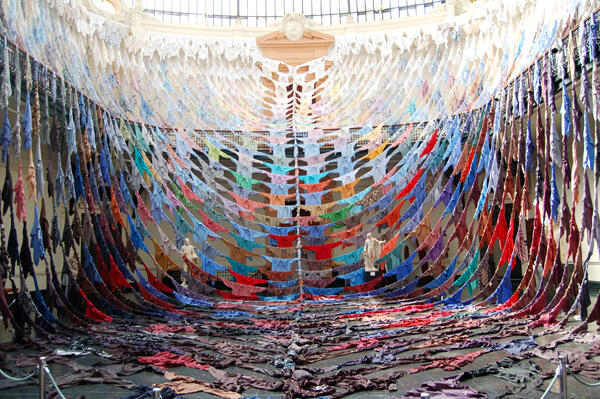
In both of them the artist makes use of the architectonic space, and through the display of garments discarded by anonymous people, she redefines this space, both from a formal and a symbolic point of view. On the one hand, “Traces” consists of more than eight hundred and fifty second-hand men’s jackets which belonged mainly to anonymous men, connected by thin ropes and covering one of the two large outdoor staircases (the Chacabuco Staircase) leading to the grand esplanade of the MMHR. “Dialogues”, on the other hand, featured close to two thousand shirts and blouses that cascade down from the edges of the high walls under the cupola of the NMFA to the floor of the Central Hall. “Traces” will run until June 30, 2013, while “Dialogues” was on exhibit until May 26, 2013.
As discarded and outdated elements, all these garments attempt to prevail over the large-scale architecture of the buildings where they are exhibited. Their presence reveals the absence of the physical body; they cover a void. Thus these substitutes come together to represent a collective force that prevails, from their ephemeral nature, over the permanence of the buildings. In the words of Julia Herzberg, the curator of the exhibitions, “The empty garments may suggest power and authority, or on the contrary, helplessness and impotence, strength or weakness.” This reading seems to give rise to a duality that is repeated in both venues. On the one hand, one may to a certain extent empathize with those bodies, perceiving a human presence that strives to be noticed, but at the same time there is the hint of a phantasmal presence, which is a reminder of the perennial nature of these garments. The fact that all the garments correspond to the area of the torso – jackets, blouses and shirts – turns out to be a categorical decision. The absence of the body that may animate them, that may make them breathe, leads the viewer to wonder about the identity of those who once wore them and the reason why they were discarded – on closer inspection, one may confirm that none of the garments shows any deterioration attributable to use; they are in good conditions. The garments are replaced by new ones, our identities are regularly updated, and it is this past which the artist retrieves, attempting to provide one last space for reflection. The status of the work as a site-specific installation, conceived for a given place and time, reveals a search for a certain moment of union between these people who perhaps had no relationship with one another, but it also inspires the wish to redefine spaces on the basis of common projects that connect them –in this particular case, the artist’s work. This possibility of bringing strangers together may also be seen in earlier works of hers, as for example, Are We Still Going On?, a title which indicates, precisely, this interest in collective activity and the search for a possible common project.
Bearing this in mind, we may say that both exhibitions make use of the buildings not only formally but also symbolically. In the case of “Traces”, the MMHR immediately carries us back to the past and reminds us of the events that took place during the military dictatorship. Thus the presence of the installation outside the museum acts as a memento and imbues the building with a metaphorical character which brings those events to mind. The ephemeral nature of the garments takes precedence over the monumentality of the museum, redefining this external space. As indicated by its name, from its precariousness “Traces” attempts to leave a trace that will inevitably disappear. It is a moment in the museum’s external space that reminds us of what this place commemorates; something that routine may cause us to forget. The garments are weathered by the sun, and it is precisely the sun that gradually discolors them, fading them in a rather neutral chromatic scale ranging from the darker tones at the bottom of the stairs to a lighter tone at the top. A pair of jackets stands out from the order established by the artist, with their fronts instead of their backs facing upward. The individuality, the anonymity of some does not only refer to collective activity but also to personal, intimate stories that gradually intertwine. Only during this fleeting instant are these stories linked together to account for a common past which, despite the absence of the persons involved, does not wish to be forgotten.
In “Dialogues”, on the other hand, the garments are exhibited inside the National Museum of Fine Arts, and are therefore protected from the sun. The chromatic effect of the clothes which, in turn, retain the saturation of the original color, refers to a present, or at least to a more recent use. Shirts and blouses cascade under the cupola joined together by the sleeves, thus reformulating the museum space. The rounded shape of the cascading garments replicates, to a certain extent, the shape of the cupola in a symmetry that deforms the space. Under the stability of the cupola a new fragile and ephemeral cupola is created; one which, through the collective arrangement of the garments linked together, and through their chromatic saturation, take precedence over the museum’s Neoclassical architecture. As they ascend towards the cupola, the color of the garments becomes lighter and reaches pastel tones at the top. This color shift emphasizes the perception of roundness of the structure created by the garments, intensifying the impression of its being an inverted cupola. This new architecture generates new relationships with the viewers, explorations that acquire a new meaning. The sculptures in the permanent collection are trapped amid the garments; the second floor can be toured under the cupola formed by the garments, thus allowing the viewers to examine them individually in detail. The impact of the ensemble of garments that succeeds in redefining the museum’s exhibition space induces reflection on the power of this unifying activity which, despite its being a temporary exhibition, raises the question of the capacity of the collective to generate changes in the environment. In the light of the museum’s past, the garments are present for some moments to account for this possibility: personal stories, the stories of each individual come together in anonymity and in absence to suggest the idea of a common project.
-
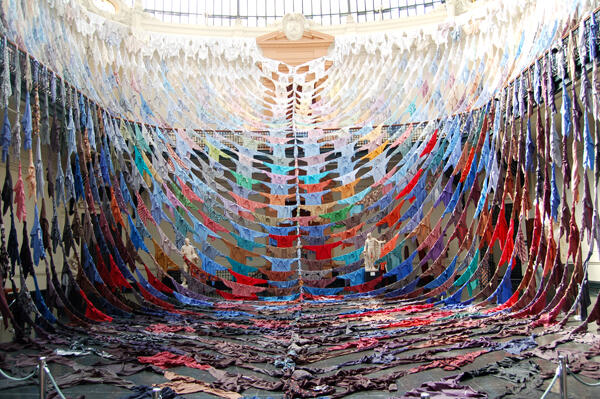 Diálogos, 2013
Instalaciones en el Museo Nacional de Bellas Artes (Chile), camisas amarradas entre sí, 2013
Credito: Matías Valenzuela
-
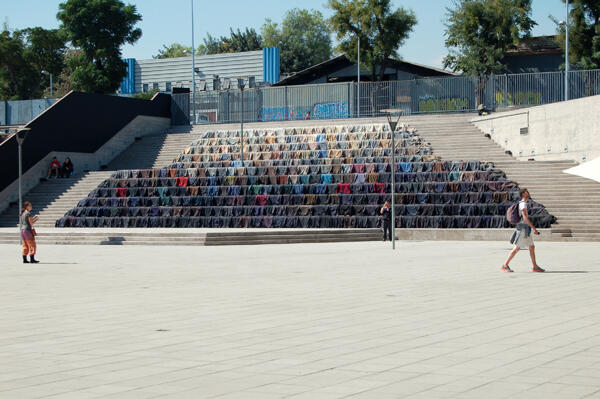 Huellas, 2013
instalación en el Museo de la Memoria y los Derechos Humanos (Chile), camisas y chaquetas, 2013.
Credito: Matías Valenzuela
-
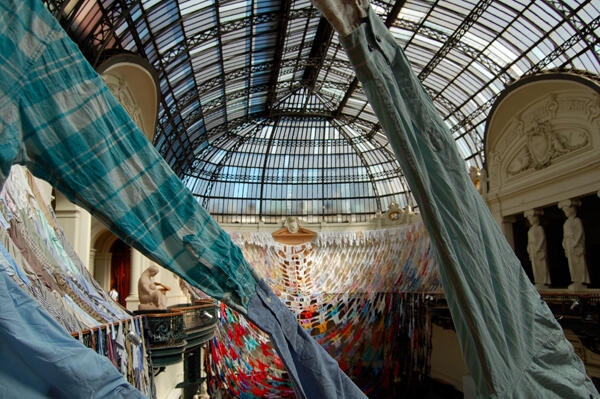 Diálogos, 2013
Instalaciones en el Museo Nacional de Bellas Artes (Chile), camisas amarradas entre sí, 2013
Credito: Matías Valenzuela