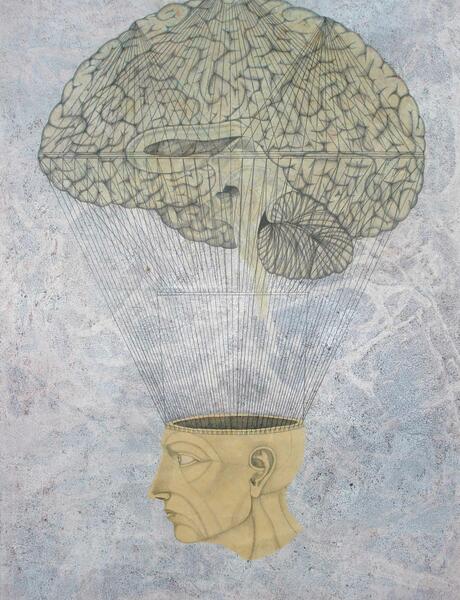
Carlos Estévez´s First Retrospective (1992 – 2009)
Since the last November, the University at Buffalo Art Gallery is presenting "Carlos Estevez: Images of Thought," an exhibition that features 31 works by the Cuban-born artist,curated by Jorge J.E. Gracia, PhD, SUNY Distinguished Professor and Samuel P. Capen, Chair in Philosophy and Comparative Literature at UB, and the author of "Images of Thought: Philosophical Interpretations of Carlos Estevez's Art" (2009, SUNY Press).
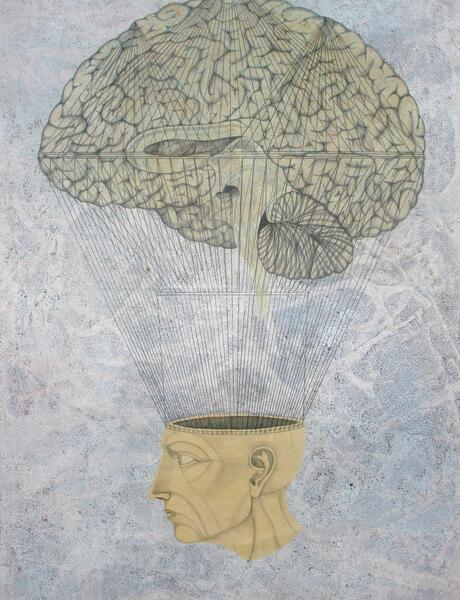
Clemens Hall, the VIII Samuel P. Capen Symposium "Thinking with Images", gave a lecture about the roots of Estevez's work and how the images he uses affect our understanding of the philosophical issues he posses.
Also, his work was analyzed by Holly Block, executive director of the Bronx Museum of the Arts, a champion of new artists, who is considered one of New York's most adventurous and creative curators. and cultural historian Charles Burroughs, Elsie B. Smith Professor of Liberal Arts at Case Western Reserve University, whose work focuses on responses to and reactions against the classical tradition in the visual arts and in architecture.
Gracia says the exhibition represents all aspects of the career of Estevez, whose art has attracted substantial attention in Europe, the United States and Latin America, where it is found in major public and private collections. Estevez's art forms range from sculpture and installation, to oil and acrylic on canvas and paper, drawings on paper, assemblage, collage and combinations of each. He works with traditional materials, but has incorporated non-traditional elements like bottles, dolls and gadgets he finds in rummage sales and flea markets, into his art.
According to the curator, many of his later works feature dynamic images of human and animal forms over technical, linear drawings. These figures often reference constellations and the greater space of the cosmos, by using lines to connect star-like dots. While at the same time, they remain grounded in human space by allusions to marionette puppets.
The pieces in " Images of Thoughts" represent his artistic practice from 1992 to 2009, and illustrate the focus in a lot of Estevez's work: the expression, through visual images, of complex philosophical problems and ideas prompted by the human predicament. Gracia says, "Through them he asks about the source of knowledge, the role of reason and faith in understanding, how we communicate with each other, whether women and men have a common perspective or see the world differently, whether we are free or controlled by forces we cannot avoid and if our destiny is predetermined."
The world of images Estevez creates for us is intended to make us understand the complexity of these questions and to lead us to answers of our own. His art is a laboratory of sorts, an observation platform," Gracia says, "The mind behind the work is as fascinated with new discoveries as that of Renaissance and Enlightenment scientists and explorers. This quality accounts in part for the philosophical character of Estevez's creations. Every piece has a philosophical twist, poses a conceptual puzzle, presents a controversial view, reveals an existential predicament or uncovers an intuition about humans and their predicaments. According to Gracia, "his work is child-like in that it has a playful, ingenious character associated with our early lives. "But," says Gracia, "it is also scientific in its clever engineering feats, and it always displays a deep curiosity and insight into the world and humanity. We are asked to look at it and ponder, as children do in a puppet show, fascinated by the possibilities opening before our eyes. "
"The modern and archaic, the avant-garde and traditional, the conceptual and formal, the strong and the delightful are combined in the artistic universe " he says, " it draws the observer into a universe of wonder. And, although the art seems to be driven by ideas, it makes no statements. Its inherent ambiguity leads to questions rather than answers, a reason why it eminently serves as an instrument of philosophical reflection."
The exhibition will be accompanied by Gracia's book, which presents philosophical interpretations of 18 works by Estevez, corresponding full-color images and an interview with the artist.