
Blanton Museum
The Good Things of the 1990s
Asource of pure aesthetic enjoyment, the first comprehensive exhibition dedicated to the Rojas Cultural Center of the 1990s leaves the visitor with a feeling of spiritual lightness. Open to the public until May 22 at the Blanton Museum at the University of Texas at Austin, USA, Recovering Beauty is a can’t miss event for those fortunate enough to find themselves in this corner of the world.
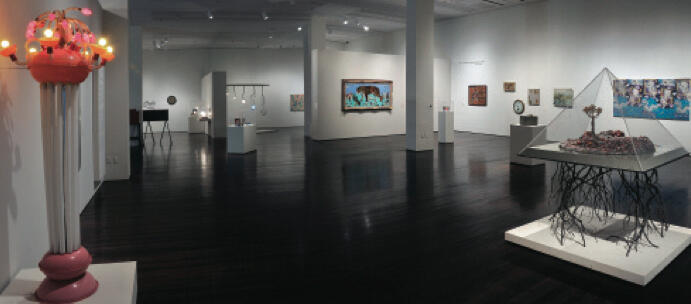
The exhibition curator, Úrsula Dávila-Villa, a young Mexican woman, explains that she owes the inspiration for the show to judge/collector Gustavo Bruzzone who, when she was visiting Buenos Aires, gave her access to his house, his library and his artworks: “He began the tour of his collection, and it somehow represented a story of affection and friendship at a very important period (...) To see somebody whose profession has nothing to do with affection but is related, rather, to ethics and the law, and then to witness the intensity of his commitment [to these artworks] was a sign that something had happened that needed to be told.” This is how Recovering Beauty: The 1990s in Buenos Aires was born as an exhibit that follows the Rojas Cultural Center in the 1990s and revisits crucial works that left their imprint on Argentine art of that period, such as Feliciano Centurión’s Pulpo blanco (1993), Sebastián Gordín’s Biznikke (1995), Miguel Harte’s Jardín de las delicias (1993), Marcelo Pombo’s Navidad en San Francisco Solano (1991), and Cristina Schiavi’s Te invito (1993), to name only some of the 70 works on display.
The slates that introduce the Argentine context are written in rather simplistic terms (they take the dictatorship as point of departure and compare it with democracy in terms of “repression” versus “social liberation”), assuming that the audience has no relationship whatsoever with Latin American art or history. However, after this first reading, one of the many achievements of the exhibition is that it becomes completely detached from the introduction’s pedagogical perspective and invites the visitor to explore six main sections that suggest a particular interpretation, but that also leave a great deal to the imagination and allow the visitor to enjoy the works, while also highlighting the diverse character of each theme.
The first section introduces the Rojas Center and its mentor, Jorge Gumier Maier, and then moves on to the exhibition of other thematic sequences such as “Beauty and Ordinary Materials”, “Playful Abstraction”, or “Shared Influences”,whichgrouptogether,respectively, some of the works developed with modest and inexpensive materials, those which implicitly make reference to the concrete art of the 1940s in Argentina, and others that share Andy Warhol or Marcel Duchamp’s use of Pop culture and industrial objects in the creation of the works themselves.
Along the tour of the exhibition, there are two moments that surprise the visitor in different ways. On the one hand, one of the last sections entitled “Legacy and Affection”, proposes a space shared by works such as Feliciano Centurión’s embroideries and Omar Schirilo’s light installations. In these works there is a clear reference to the AIDS epidemic that drastically marked the 1990s and that was also the cause of death of both artists. In this sense, the decade proposes the existence of a contradictory territory in which play and enjoyment of beauty coexist with a more cathartic and therapeutical use of art that is deeply touching. On the other hand, in the center of the exhibit, defined by its open spaces and long perspectives, the visitor encounters Benito Laren’s (1991) Buscando Precios (Looking for Prices), which features a large tiger walking amidst local and imported products. After more than a decade in exile at the basement of the Argentine Consulate in New York, where the work was exhibited only once at the end of the 1990s and where it had remained ever since, one of the greatest achievements of this exhibition has been to bring Laren’s work out of the basement, transforming the exhibit’s title, Recovering Beauty, into reality. The journey on which this painting embarked seems almost surreal: it was originally conceived as a sign for a store named “Tiger” in Laren’s native city, San Nicolás, in the province of Buenos Aires, as a “curious visibility strategy for his work, based on the supermarket clients,” in the words of Gustavo Bruzzone. When the owners of the store returned the painting, Laren took it to the United States to try his luck, but he returned to Argentina without it. Years later, in the late 1990s, Laren was invited to show his work at the Consulate, and that is where Buscando Precios remained until it was recently donated to the Blanton. This is how the work was recovered, going from the darkness of a basement to occupy the space with the greatest visibility in the exhibition Recovering Beauty, imbuing the title of the show with meaning.
Recovering Beauty marks a time of pivotal transformation for various reasons. First, because it succeeds in telling a story about the Rojas Gallery in the 1990s based on a narrative that respects the diversity of the artists; that exposes the visitor to the hilarious irony of the period, from its fissures and upsetting experiences to the exploratory spirit of the artists, who have constructed a singular aesthetic vocabulary that stands apart from many contemporary expressions in Latin America, challenging the apparent equalizing power of Neoliberalism in art. Secondly, as Andrea Giunta, a professor at the University of Texas explains, in spite of the fact that “the 1990s in Buenos Aires were and were not the Rojas Cultural Center, and many other things happened during those years, the exhibition profile offers a gaze into a complex art scene and, at the same time, it renders the scene that it intends to approach complex. The resulting tension is one of the elements that make this an excellent exhibition.” Lastly, from a formal and a spatial point of view the installations superbly demonstrate the universe of the Rojas Center of that decade, both from a formal and a spatial point of view, without falling into the temptation to classify the works or the artists in order to make them fit into sterile definitions. It opens up possibilities and presents an open and permeable horizon that allows multiple readings, but also implies taking risks. The word “beauty” included in the title of the exhibit itself is already a sign pointing to the fact that this is an amusing bet, but also one that is risky, light, defiant of the great artistic traditions, funny and at the same time, moving.
-
 Recovering Beauty: The 1990s in Buenos Aires, the exhibition of the Rojas Cultural Center at the Blanton Museum/ Recuperar la Belleza: los 90 en Buenos Aires, la muestra del Rojas en el Museo Blanton
 -
 Recovering Beauty: The 1990s in Buenos Aires, the exhibition of the Rojas Cultural Center at the Blanton Museum/ Recuperar la Belleza: los 90 en Buenos Aires, la muestra del Rojas en el Museo Blanton
 -
 Marcelo Pombo. Christmas in San Francisco in Solano, 1991. Cardboard, nylon, and synthetic enamel on wood, 31 1/2 x 47 1/4 in. Navidad en San Francisco Solano, 1991. Cartón, nylon y esmalte sintético sobre madera, 80 x 120 cm. Mauro Herlizka, Buenos Aires.
 -
 Feliciano Centurión. White Octopus], ca. 1993. Acrylic on polyester blanket, 95 x 84 in. Museum purchase with funds provided by Don Mullins. Pulpo blanco, ca 1993. Acrílico sobre manta de poliéster, 241,3 x 213,3 cm. Adquisición del museo con fondos provistos por Don Mullins.