Alberto Baraya at the Frost Art Museum, Miami
The Colombian artist Alberto Baraya is presenting the exhibition “Naturalism/Artificiality: Expeditions, and Research of the Herbarium of Artificial Plants!, curated by Francine Birbragher at The Patricia & Phillip Frost Art Museum, Miami.
For more than a decade, Baraya has produced works of art which question and parody the agendas and empirical objectivity of seventeenth, eighteenth, and nineteenth-century European expeditions that purported to scientifically collect and quantify the indigenous flora, fauna and peoples of the Americas.
His exhibition presents his findings and projects based on travels to Acre (Brazil), Bogotá (Colombia), Gainesville, Indianapolis, and Long Beach (USA) and Machu Picchu (Perú), and includes selected works from the series “Herbarium of Artificial Plants”, “The Fable of the Birds”, and “Anthropometries”.
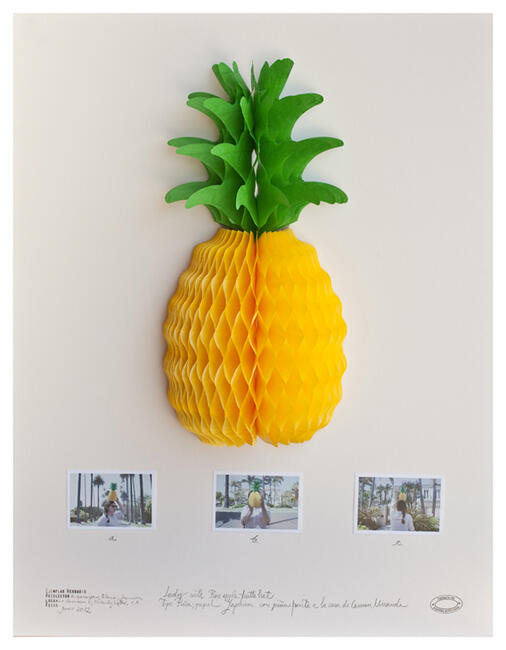
Baraya began to explore the idea of mystification and artificiality through the series “ Herbarium of Artificial Plants”, which focuses on documenting fake plants and flowers. Gathering man-made objects inspired by nature and studying the way these were used in various places, allow him to analyze how different societies have been shaped over the years. The “ Herbarium” series, which is an ongoing project, goes beyond the simple act of collecting. By studying what he gathers, it is possible to identify his intentions and his needs, and to analyze the social and cultural context of his findings. Visually and conceptually, his taxonomies remind us of the images produced by European scientists during seventeenth, eighteenth and nineteenth century New World expeditions. At that time scientists collected, dissected, classified, and framed species of native fauna and flora, with the ulterior motive of controlling and exploiting new territories. Two centuries later, Baraya appropriates similar forms of scientific representation to create taxonomies of artificial flowers and plants, and to analyze and question today’s realities.
Baraya’s expeditions allow him to analyze the particularities of different societies. This is clearly illustrated in one of his most recent projects, “ Anthropometries”, which includes a series of photographs taken during a trip to Machu Picchu, Peru. During this expedition, he used a tool applied by early physical anthropologists to identify and understand the human and physical variations of Native Americans, correlating certain human characteristics to ethnic and racial factors. He asked local people and tourists to measure him with an anthropometric caliper, inversing the role of the explorer. Through this series, he criticizes the scientific theories of the late-nineteenth and early-twentieth century, and proposes a revision of the concept of “discovery” between individuals and cultures.
The exhibition “ Naturalism/Artificiality: Expeditions, and Research of the Herbarium of Artificial Plants” presents Baraya’s findings and projects based on travels to Acre, Bogotá, Gainesville, Indianapolis, Long Beach, and Machu Picchu, and includes select works from the series the “ Fable of the Birds”, “Herbarium of Artificial Plants”, and “Anthropometries”. The exhibition is a sort of album, a collection of “collections,” an illustrated travel journal we can admire and interpret based on our own journeys and experiences.
In his “ Herbarium of Artificial Plants”, Baraya uses found objects such as silk, plastic or glass flowers and leaves, to create beautiful taxonomies. Science and art are combined with drawings and annotations related to his research, as well as to the social and political implications of his findings. Perhaps the most ambitious project of the Herbarium series is the “ Latex Tree”, originally produced for the 27th São Paulo Biennial. The outer layer of the latex tree was peeled off from the man-produced tree and exhibited during the biennial. In addition to presenting a visually striking piece, the project provided a commentary on the exploitation of rubber in nineteenth-century Brazil . “ The Fable of the Birds” features photographs of stuffed birds, typical of the Americas, leading the viewer to different ways of contemplating controlled landscapes: the landscape of dissected and stuffed birds as a scientific instrument and their relationship to the landscape of their natural habi tat. “ Anthropemetries” focuses on anthropometry, a tool for early physical anthropology that was used to identify and understand the human and physical variations and to correlate these characteristics to ethnic and racial factors. In these works, Baraya revises not only the archaeological exploration of the area of Machu Picchu, but proposes a reflection on the idea of “discovery” of a culture by the hands of another, having his measurements taken with an anthropometric caliper by natives and tourists from all over the world.
As Doctor Carol Damian, director of the Frost Art Museum points out, Baraya’s construction of an “ Herbarium of Artificial Plants” simply elaborates upon the same process of gathering the species, documenting each with the meticulous precision we have come to associate with botanical illustration, giving it a name, and entering it into the record. Baraya’s ironic and cynical comments on the scientific and our ready acceptance of a scientist’s, botanist’s or traveler-artist records results in a new aesthetic as a re-assessment of the wonders of the “New World” (which was not New or Discovered anyway—people had been here for thousands of years). Just as the European traveler came to America with expectations of the remote and strange and was not disappointed with the vast wilderness that appeared, a visitor to this exhibition of Alberto Baraya’s new taxonomy of exotic species will also not be disappointed as the absurdity of his scientific evidence comes to light.
“Naturalism/Artificiality: Expeditions, and Research of the Herbarium of Artificial Plants” , curated by Francine Birbragher, will run through January 5, 2014. It is part of the Frost Art Museum’s 2013 series of exhibitions: “ Commemorating 500 Years: Spain-Florida-Caribbean”.
The Frost Art Museum at Florida International University opened its current 46,000-square-foot state-of-the-art building in November 2008. Admission to the Museum is always free. The Frost is an American Association of Museums accredited museum and Smithsonian affiliate,
-
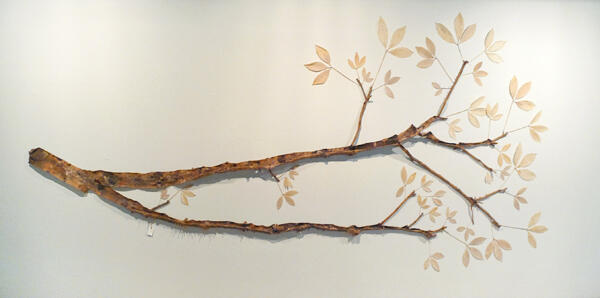 Latex Tree Project, Branch B (Proyecto Árbol Látex, Rama B), 2006, Latex cast,
78 3/4 x 197 x 4 inches, Courtesy of the Artist
-
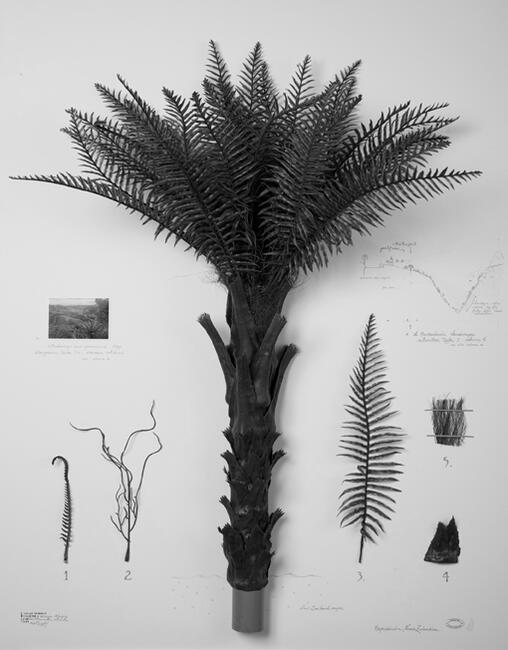 Herbarium of Artificial Plants, Expedition New Zealand (Herbario de Plantas Artificiales, Expedición Nueva Zelandia), Plate 04, 2009, Plastic fern (made in China), photographs and drawings on cardboard, 43 3/4 x 32 1/4 x 2 inches, Courtesy of the Artist
 -
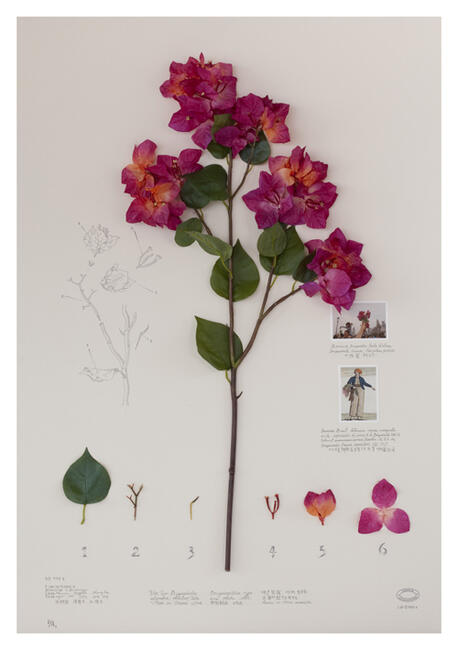 Herbarium of Artificial Plants, Bougainvillea (Herbario de Plantas Artificiales, Buganvilla Baret o Baretillia), 2012, Silk found object (made in China), wire and plastic, 22 x 32 x 2 inches, Private collection, Miami
-
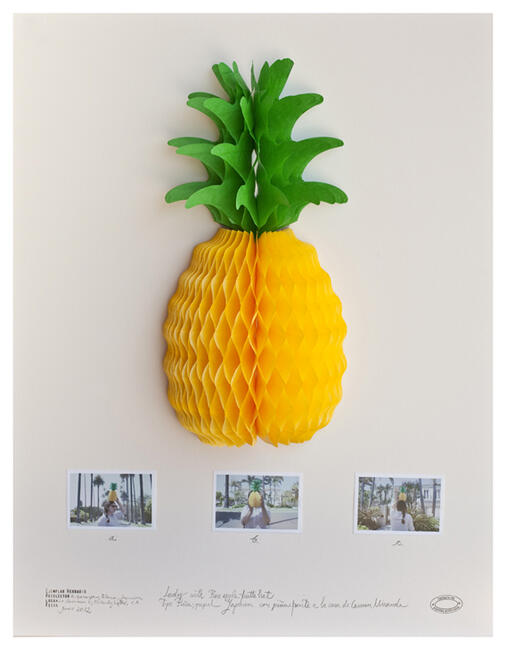 Herbarium of Artificial Plants, Expedition California, Miranda Pineapple (Herbario de Plantas Artificiales, Expedición California, Piña Miranda), 2012, Found object, drawing
and photograph on cardboard, 23 3/4 x 17 3/4 x 2 inches, Courtesy of the Artist