
Adriana Varejão
Outside the Center
Adriana Varejão’s passionate and generous oeuvre opened Malba-Fundación Costantini’s 2013 exhibitions season after having previously been shown at the Museum of Modern Art in Sao Paulo and the Museum of Modern Art in Rio de Janeiro. The retrospective exhibition “Adriana Varejão.
Histories in the Margins”, curated by Adriano Pedrosa, comprises numerous paintings, but also sculpture, drawing and photography. The show presents a panorama that includes some forty works by one of the most important and highest-paid visual artists of her generation.
E xuberant Tales
Since only a few pieces had been seen in Buenos Aires previously, at the Museum of Modern Art, the public welcomed the display of Varejao’s multifaceted works displayed in a chronological sequence, starting with her most significant series, such as Tierra incognita, Proposal for a Catechesis, Academics, Irezumis, Tongues and Incisions, Cured Meat Ruins, Seas and Glazed Tiles, Saunas, and Plates, alongside works which had been presented in the 1994 and 1998 Sao Paulo biennials.
Oscillating between appropriation and reinvention, her “outside the center” works articulate many tonalities and voices. They draw upon the culture of Brazil, which originates in the mixture of African, native, and Portuguese cultures. They also show expressions and allusions to Japanese and Chinese traditions. Varejão portrays herself as a Chinese, Moor, Black and Indian woman; cultural hybridization in action. Is this a way of complying with the patina of exoticism that may be expected from someone that hails from the country of football and Carnival, of exaggerate beaches and a great economy?
The large-format works recreate cultural affiliations, migrations and mirages; they are linked to the baroque tradition, as in the case of those blue glazed tiles, densely ornamented with an unusual imagery. They explore issues of the spirit and of the flesh. The images feature bodies that mutate, multiplying the presence of fragments and viscera, blood and cuts (and sutures) that are related to the erotic rather than to suffering.
“ The body is revealed as the skin and flesh of painting, inhabiting the interiors of architecture and unveiled in its ruins”, Pedrosa points out.
Even though it is closely associated to the Counter-Reformation, and in particular to the Order of the Jesuits, who also brought it to America in their missions, the Baroque is not a style exclusively linked to the religious. In this exhibit many works, featuring crosses and meanings with permeable edges, portray the sacred but also account for the profane and for reason. And there is more; landscapes, maps and travels, architectonic spaces that are re-signified through images that tend toward geometric abstraction and the modernist grid pattern. It is precisely hybridization and contamination that may be found in the powerful work of Varejão following the notions posited in the poetic Anthropophagic Manifesto, written by Oswald De Andrade in 1928 with ingredients of surrealist humor, and based on a certain native belief that asserts that by devouring the enemy, his/her positive characteristics are assimilated. The exhibition is accompanied by a fully illustrated catalogue that includes a conversation with the artist, published by the MAM in Portuguese and English, with an annex for the texts in Spanish translated by the Malba.
Profile
Adriana Varejão (Brazil, 1964) began to show her work in 1992. She participated in nearly a hundred solo and group exhibitions. Among these, special mention may be made of those held at the Belem Cultural Center, Lisbon (2005); Hara Museum, Tokyo (2007), Fondation Cartier, Paris (2005); and of her participation in the following biennials: Istanbul (2011), Bucharest (2008), Liverpool (2006), Mercosur (2005), Prague (2003), Johannesburg, South Africa (1995) and Sao Paulo (1994 y 1998). Her works are represented in prestigious institutional and private collections, such as those of the Guggenheim Museum (NY), Tate Modern (London), Fondation Cartier (Paris), Fundación “la Caixa” (Barcelona) and Inhotim Center for Contemporary Art (Brumadinho, MG).She lives and works in Rio de Janeiro.
-
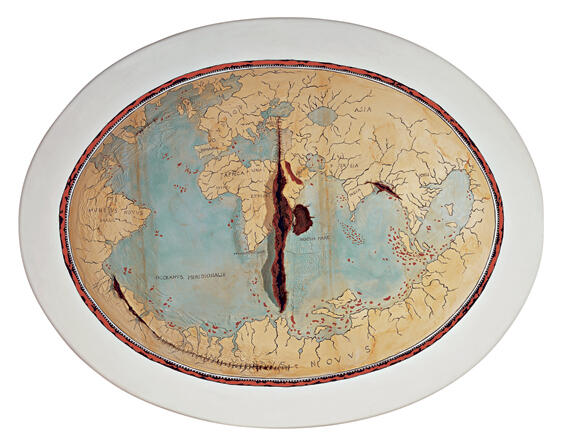 Mapa de Lopo Homem II - 1992 – 2004
Óleo sobre madera y línea de sutura 110 x 140 x 10 cm.
Colección particular - Río de Janeiro -
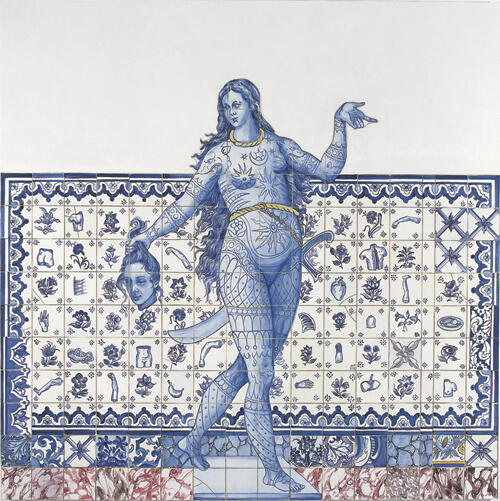 Figura de convite III - 2005 - Óleo sobre tela - 200 x 200 cm.
Colección particular - Miami -
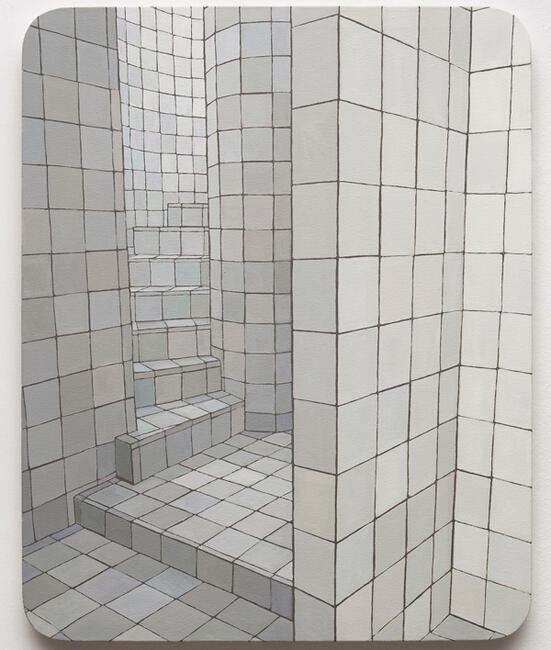 O Místico, 2005 - Óleo sobre tela - 90 x 72 cm
Colección particular - San Pablo - Foto: Sergio Guerini -
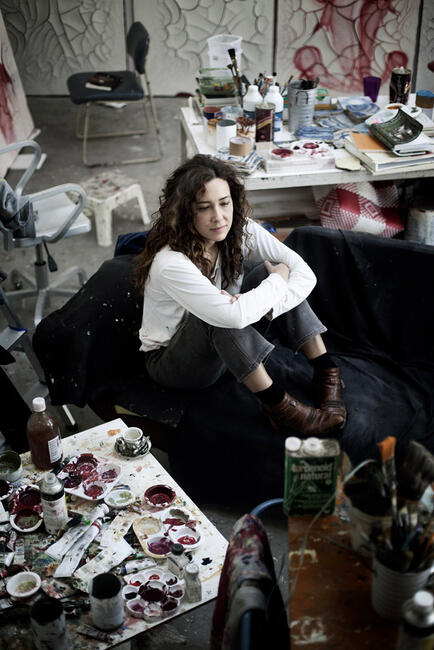
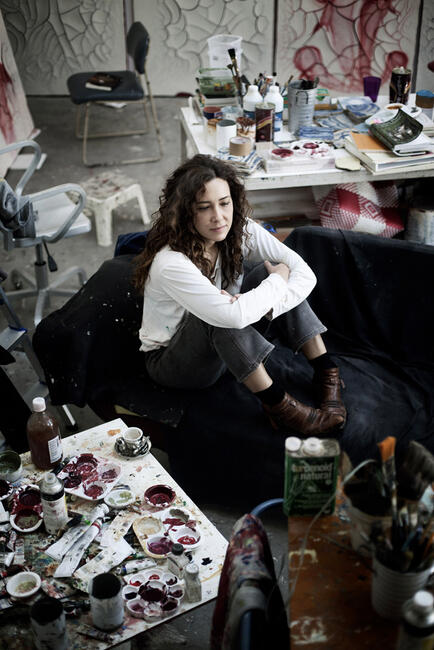 La artista.
Foto: Daryan Dornelles -
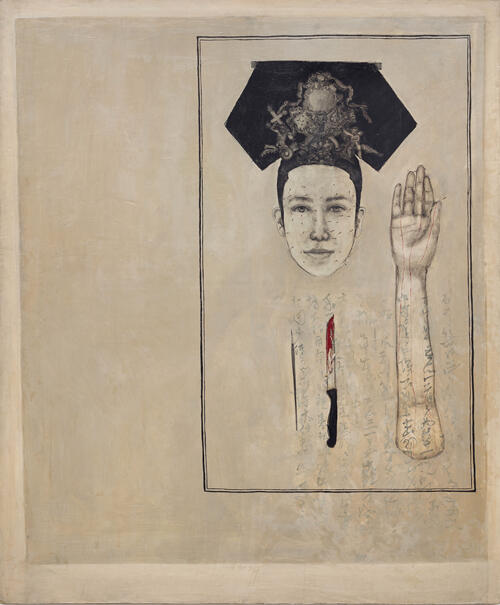 Chinesa, 1992 - Óleo sobre tela y agujas de acupuntura - 120 x 100 cm.
Colección particular - San Pablo
Foto: Sergio Guerini