

By
Álvaro De Benito
The Brazilian artist and filmmaker turns her audiovisual project at Luxembourg’s Mudam into a sensory and collective experience with which to explore historical, political, and environmental conflicts.
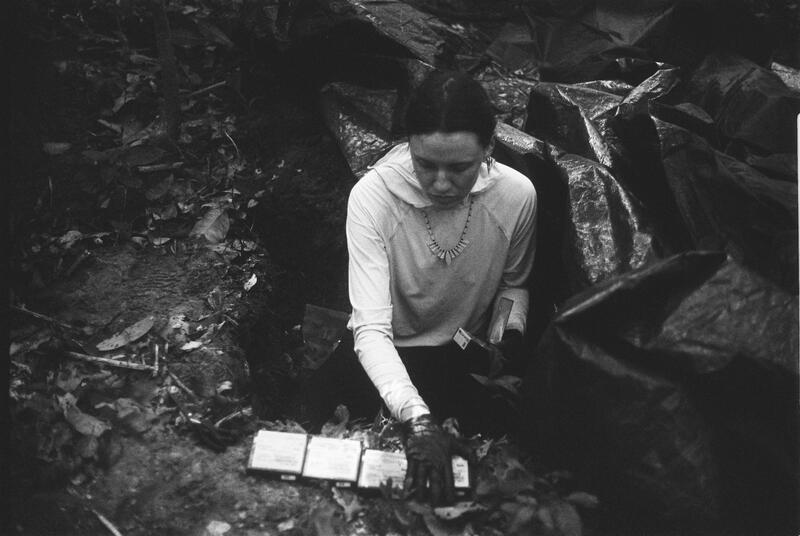
The Mudam (Musée d’Art Moderne Grand-Duc Jean) in Luxembourg hosts A câmera é o corpo, the first major museum retrospective in Europe dedicated to Ana Vaz (Brasília, Brazil, 1986). Through her experimental cinema and installations, the artist and filmmaker explores the connections between colonialism, ecology, memory, and territory, with a particular focus on historical narratives and the voices silenced within them.
Her practice offers a critique of the modes of domination through which landscapes as well as human and non-human communities have been shaped. Vaz proposes an audiovisual praxis grounded in encounter and bodily experience, while also delving into the relational. The exhibition operates upon and transforms the building's architecture into a stage where images, sounds, and installations invite an immersive experience and prompt viewers to consider the exhibition as a point of collective convergence.
É Noite na América (2022), a three-channel installation filmed at the zoo in her hometown, reflects on the displacement and disappearance of animal species resulting from urban expansion. Apiyemiyekî? (2019), for its part, delves into the consequences of colonial practices and extractivism in Brazil. Sharing this underlying theme, in Terra Preta (2025) Vaz buries unexposed film stock in the Amazonian soil, converting the earth itself into an image-making agent.
The series Meteoro (2023–2026), which addresses memories and potential urban futures in locations such as Paris, Porto, and Rome, serves as an introduction to her most recent work: Météore: Nous avons renoncé au Soleil (2026), in which this reflection is expanded through projections that present cities as spaces populated by specters.
Ana Vaz. A câmera é o corpo can be visited through May 2, 2027, at Mudam (Musée d’Art Moderne Grand-Duc Jean), Park Dräi Eechelen, 3, Luxembourg City (Luxembourg).
The co-founder of Los Carpinteros presents his first solo exhibition in the country at Château de Bourglinster and a former church in Roodt-sur-Syre.