

By
Albeiro Arciniegas Mejía
An interview with painter Olmedo Quimbita (Latacunga, Ecuador, 1965)
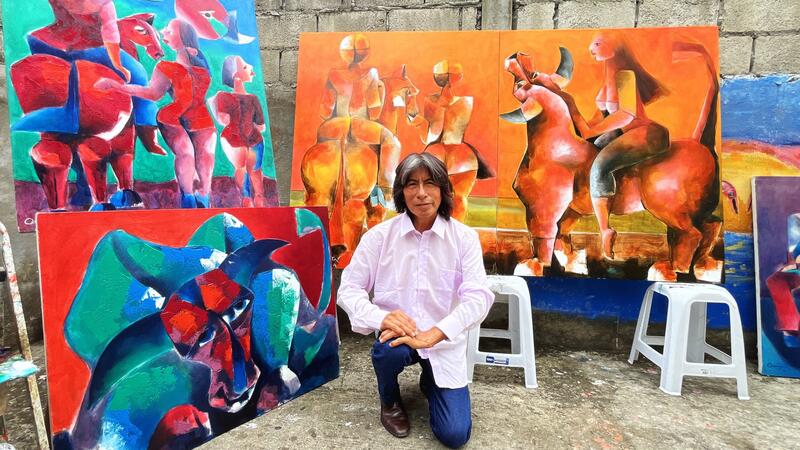
Known as “the Painter of Light,” Ecuadorian artist Olmedo Quimbita was born in Latacunga. His work carries great symbolic force and is read as a form of visual poetry. With imagination, he combines elements that seem antagonistic: themes related to nature, mysticism, women, color, or the movement of Andean settings. From Quito to the vibrant sunsets of Caracas, by way of the golden hues of Egypt and the galleries of New York, Olmedo Quimbita made light his banner, and color and form his language. The youngest of five siblings, he has had solo exhibitions in some twenty countries.
Tradition
“My palette is really Andean; when I arrived in Caracas it was light, so I had to learn to work with Caribbean tones that enriched my style,” says Quimbita. One of his works, Peregrinaje a la conciencia #2, painted during the pandemic, is a return to family unity: the pandemic opened a space for reunion, breaking the dynamic of the contemporary world that scatters human bonds. Blue predominates in this work.
In Western art, the color blue evokes notions of divinity, immortality, truth, and wisdom; in association with the sea and the sky, it evokes feelings of tranquility and freedom. Peregrinaje a la conciencia #2 has a metaphysical backdrop: the dominant blue contrasts with lunar nuances, yet blue prevails through the birds, the figures, and a sea that seems to project itself into the heights.
The metaphor of blue—so symbolic in the modernist movement—creates, in Quimbita’s case, a world of connotations that enrich the work and invite interpretation. According to Miguel Untiveros, within the Latin American painting tradition, Luis Montero, Francisco Laso, and José Sabogal are painters who are part of a search for identity and who depict the human figure in diverse conditions and geographic settings. Quimbita aligns himself with that tradition, one close to the earth. Figures in Andean dances, on bicycles, with umbrellas, often resorting to contrasting tones. Prominent lips that evoke Afro-descendant presences.
And although Quimbita doesn’t believe in style, his is a realization of very carefully conceived ideas, materialized in a symmetry and depth of color that make him one of the great reference points of contemporary painting in Latin America. We spoke with him in this interview full of nuance and human reflection.
Albeiro Arciniegas [A.A.]: Maestro, did your family’s move to Quito definitively set the course of your artistic career?
Olmedo Quimbita [O.Q.]: Yes. My interest in art began when I was seven. The urge to create, to gain knowledge, to get involved in the art world started very early, and my first steps were taken in Quito. I’m from Latacunga, but in Quito I could see a wide range of museums and art galleries, and that was very nourishing in the early days of my career. That’s where I decided I really had to devote myself to painting full time.
A.A.: Did you study anything related to art?
O.Q.: Right. At that time I began studying; my family was in Quito, and I enrolled in the Escuela de Artes at the Universidad Central. That was part of my beginnings. The other part, well, I was young and a trip to Caracas came up. I didn’t plan to stay long; it was a museum visit to broaden my knowledge. But it turned out that I sold my first paintings in Caracas, and the thrill of selling was so great that I said, no, I’m going to stay here and create. With this I can pay for my art studies, enroll in the Escuela de Artes, and buy my materials. And that’s how it happened. I stayed in Caracas painting for about three or four years; practically speaking, that was my training.
A.A.: Do you remember your artistic relationships in Caracas?
O.Q.: Yes, I had the chance to meet great masters. Back then Caracas was different. We’re talking about the eighties, and extremely important exhibitions were held there. For example, the Museo de Arte Moderno showed a collection by Fernando Botero—imagine the scale of it. There were exhibitions by Jesús Soto and Cruz Díez, and I got involved in that culture, and that was wonderful for me.
A.A.: You also spent time in Egypt, Israel, Spain, and Colombia. Let’s take a brief tour of your main exhibitions around the world.
O.Q.: Well, I was already in studies and workshops, painting and continuing to research, and from there a series of exhibitions began. First in South America, shows in Bogotá, and then throughout the continent. Before I knew it, I was living in New York, in Paris, in London. It was an unplanned journey, just like my beginnings. Being able to see museums like the Louvre, the one in New York, those of the great metropolises. That was very nourishing for me.
A.A.: Aesthetics. Style. What do scholars and experts say? How do they define the work of Olmedo Quimbita?
O.Q.: At this point, I don’t really believe in styles; I believe in daily work, in research. In my early stages I made abstract art and carried out a series of investigations with techniques from that more dissolved approach, but I came to like the figurative area more. The one where you can define things better. That’s what the art connoisseurs pick up on. Obviously, a lot of that has to do with the study and analysis that an art critic does. But that work belongs to the critic, not to me.
A.A.: How is one of your paintings born? From emotions? From images? Where is the seed of each of your creative acts?
O.Q.: Well, first of all, the painting doesn’t exist. What exists is the moment when that flow of creativity arrives, which happens only in the artist’s mind. What I call the “etheric” part. But how do you materialize it? I proceed to sketch it in pencil. I must not let that moment pass. I sketch it and, if possible, I carry out the work right away. That is, I try to close the chapter in that instant, because I know that from now until tomorrow other ideas will come, and so on: an accumulation of ideas. So it’s important to close each chapter. Each one is a work that must be finished, and I sign it, and that’s that.
A.A.: You are a reference point in contemporary Latin American painting. What advice can an established master offer to young people who are starting out, or who are passionate about the art of painting?
O.Q.: First, don’t despair. By that I mean that our youth is sometimes in a great hurry. I understand, because I was young too; you want to achieve something quickly, in a rush, and that’s not how art works. It’s a beautiful, long journey, but one that is attained through perseverance and discipline. And the other thing: sometimes young people want to sell a painting, and that’s not the point. Art has to be art for art’s sake. What do I mean by this? That to this day I haven’t managed to paint a work in order to sell it. No; I paint for myself, for my pleasure and enjoyment. That’s why my work, fortunately, is successful: because I am communicating, not aiming at a sale. Art is the communication of the message I want to convey. Now, if a collector, an art lover, connects with that idea and buys it, well, that’s another matter.
A.A.: “The Painter of Light” is a poetic way to describe you and your work. What are Maestro Quimbita’s new projects? What have you been working on lately?
O.Q.: “The Painter of Light” comes precisely from what I mentioned at the beginning, when I made that shift from Andean light to tropical light. My palette of gray is a splendid flash of light and its variations. But now, for example, I’m also interested in another kind of light. Painting childhood. What is a child like? Light. Tenderness. Purity. So there is another, more advanced language, which is still light but which, in this case, would be a spiritual light. That’s what I’m working on, and with that idea I’m preparing my new exhibitions.
References
Untiveros, M. A. M. (2024). “Estética contemporánea andina” La figura Humana en la Pintura Ayacuchana 2000–2020. EDUCARE ET COMUNICARE Revista de investigación de la Facultad de Humanidades, 12(2), 52-66.

The Mexican cultural practitioner and president of CIMAM discusses the principal challenges facing museums—from diversity and funding to ethics and independence—ahead of the Annual Conference of an organization seeking to broaden the voices participating within it.
We spoke with Daniel Vega, director of Faro Santander, to address the cultural strategy of the center, its commitment to territorial engagement, and the controversy surrounding the Gelman Collection, which anchors one of its inaugural exhibitions.