
By
Karman Cubiná, Silvina
The psycho-geographical experience of Venice*
In June, more than 77 countries and 200 artists came together in one of the most venerable events in the art world: the Venice Biennale. The opening of the Venice Biennial in early June is the locus and center of the art world every two years, gathering artists, curators, collectors and museum directors, as well as socialites, oligarchs and movie stars.
September 25, 2009
The artistic direction of each edition of the biennale is entrusted to a different curator and by definition, each exhibition acquires a unique style, curatorial spirit and philosophy expressed mainly in exhibitions at the Arsenale and what used to be called the Italian pavilion (now called Palazzo delle Esposizioni della Biennale). This year, the 53rd Venice Biennale was curated by Daniel Birnbaum, Director of Staedelschule in Frankfurt-am-Main, Germany and its prestigious art space, Portikus. Born in Stockholm in 1963, Birnbaum is the youngest Artistic Director in the history of the biennale. The title of his exhibition “Fare mondi/ Making Worlds--- as described by Birnbaum expresses his “…wish to emphasize the process of creation. A work of art represents a vision of the world and if taken seriously, it can be seen as a way of making a world.” Fare Mondi presents a multi-generational list of artists indiscriminately practicing in all media and historically anchored by seminal artists such as Andre Cadere, Oyvind Fahlstrom, Gordon Matta-Clark, Yoko Ono, Blinky Palermo and Lygia Pape. In an unassuming section of the exhibition, in fact, there was an arresting “mini-exhibition” of important 1950’s works of art of the Japanese Gutai group, including Atsuko Tanaka’s famous electrified dress.
The National Participations mainly presented in the historical pavilions of the Giardini, but also in the Arsenale this year and in off-site venues, encompasses a record 77 countries, including first-time participations such as Montenegro, Principality of Monaco, Republic of Gabon, Union of Comoros and the United Arab Emirates.
The United States representation, Bruce Nauman: Topological Gardens, occupies three sites: the United States Pavilion in the Giardini and two offsite venues: l’Universita IUAV di Venezia at Tolentini and Universita Ca’ Foscari. In a sparse installation, the pavilion includes among other works, Nauman’s 1983-88 outdoor neon work Vices and Virtues, embracing the entire perimeter of the façade of the building. This work effectively transforms the challenging neo-Classical architecture of the building, using it to blur the public/private, indoor/outdoor spaces of this exhibition. Organized by the Philadelphia Museum of Art, this ambitious exhibition explores the career of one of the most influential living artists who for forty years has explored the limits of production using language and conceptual thought in virtually all media.
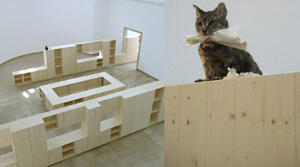
Another pavilion of note is Germany represented by Liam Gillick in a large-scale work in non-characteristic plywood resembling functional kitchen cabinets in a continuous formation spanning the various rooms of the exhibition space. Upon first encounter, the clean design element of the installation both inspires and confuses the viewer and not until he/she perceives the stuffed cat atop the cabinets, does the work come together brilliantly. The Dutch Pavilion presents Amsterdam-based film and video artist Fiona Tan’s exquisite videos of language-based portraits and non-linear stories, where word and image overlap, shifting between the visual and the literal. This year, an important and symbolic gesture is the first-time inclusion of the Latin American pavilion within the Arsenale. Curated by Irma Arestizábal, the exhibition presents artists from Bolivia, Colombia, Costa Rica, Cuba, Ecuador, El Salvador, Guatemala, Honduras, Peru and the Dominican Republic. Three artists of note are: Darío Escobar’s Kukulcan Installation made out bicycle tires, consistent with the artist´s longtime research project related to the re-contextualization of the object as a piece of art; Raquel Paiewonsky fusing elements of urban life, stereotypes, nature, spirituality and instinct; and Federico Herrero’s vibrant, abstract paintings using the colors and patterns inspired by plants, birds, and the sky.
Without a doubt though, the pavilion that attracted the most attention during the opening was the first-time collaboration between the Nordic (Sweden, Finland and Norway) and Danish pavilions with an exhibition titled ‘The Collectors”. Curated and staged by duo artists Elmgreen and Dragset, the spirit of this collaboration was in “creating a transnational neighborhood within the context of the Venice Biennale”. Known for their explorations of scenographies and power relations, these artists re-created an allegorical stage set where two interrelated fictional portraits are presented. “The Collectors” as the title suggests, is an exploration of collecting, a practice combining intimacy with exhibitionism; and negotiating obsession with self-expression. The domestic settings, one for sale and guided though by a real estate agent, revealed the private/public lives of individuals and included elements of design as well as works of art by well-known artists such as Terence Koh, Maurizio Cattellan, Jonathan Monk and our very own Miami artist, Hernan Bas.
The 53rd International Exhibition’s Golden Lions for Lifetime Achievement were awarded to two influential and important artists: Yoko Ono and John Baldessari. A jury comprising international art world figures awarded three prizes: two Golden Lions, one for Best National representation: the United States with Bruce Nauman; and one for Best Artist of the exhibition Fare Mondi: Tobias Rehberger, as well as a Silver Lion for a promising young Artist in Fare Mondi: Nathalie Djurberg. The jury also decided to assign four Special Mentions this year to: both Lygia Pape and Roberto Cuoghi in Fare Mondi; Michael Elmgreen & Ingar Dragset for the Nordic and Danish Representation; and Ming Wong exhibiting in the Singapore Pavilion.
* Executive Director, Bass Museum of Art
...............................................................................
*Note: I borrowed this title from a quote by Hans Ulrich Obrist, curator and friend. As we walked through Venice a few years ago, we were lost and he described walking the streets of Venice as a “psycho-geographical experience”.
-
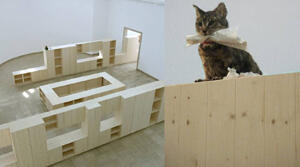 Liam Gillick's 'How Are You Going To Behave? A Kitchen Cat Speaks' for the German Pavillion, Giardini, Venice Biennale, 2009 . Un Gato de Cocina habla para el Pabellon Alemán, Giardini, Bienal de Venecia, 2009.
 -
 Fiona Tan
Disorient, 2009. HD Installation, colour, 5:1 surround, 2 HD-cam safety masters, 2 HD projectors, 2 computers, surround amplifier, surround speakers, edition of 4. Instalación en alta definición, color, 5:1 surround, 2 cámaras de seguridad de alta definición, 2 proyectores de alta definición, 2 computadoras, amplificador surround, parlantes surround, edición de 4.
© Fiona Tan. Courtesy/Cortesía: Fiona Tan & Frith Street Gallery, London
-
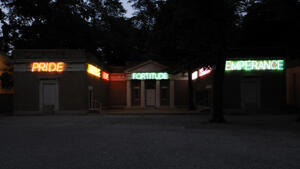 Vices and virtues
Installation shot of an exhibition copy of Bruce Nauman, Vices and Virtues, as installed on the frieze of the U.S. Pavilion. Neon and clear glass tubing mounted on aluminum support grid.