Leopoldo Torres Agüero
like a butterfly in the wind
In painting, improvisation is a state of grace in which the spirit becomes a butterfly in the wind. .
Leopoldo Torres Agüero
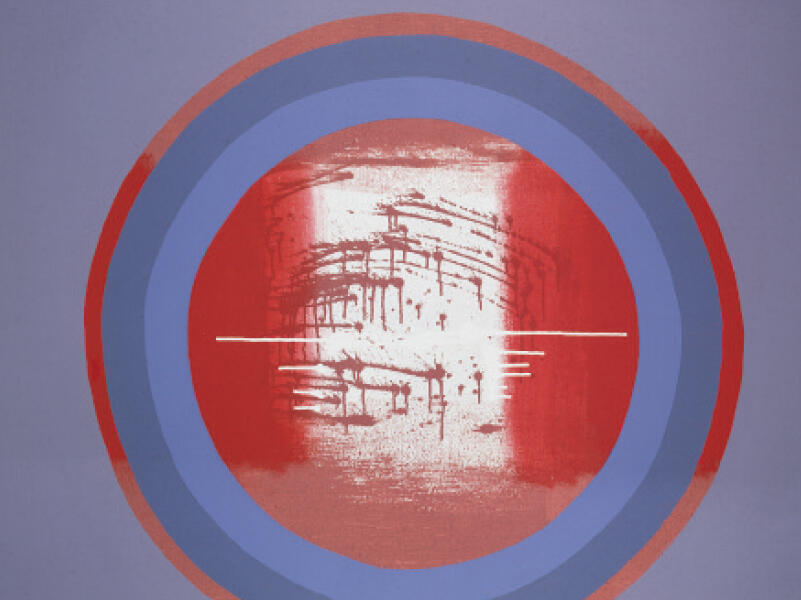
A musician and painter, concerned with the human figure and the landscape, mural art and spontaneous symbols, the effects of light and the vibration of nuances, Leopoldo Torres Agüero was, in all the stages of his production, an artist inclined to experiment with form and color.
Following his initial formative stage in the Argentine province of La Rioja, in 1941 he settled in Buenos Aires to continue perfecting his training, and after having obtained one of the prizes awarded by the National Salon, in 1949 he decided to travel to Paris. While he was a resident at the Maison Argentine de la Cité Universitaire, he befriended Cândido Portinari. This contact reinforced his interest in the monumental art which he put into practice in the shopping malls designed by the Aslán & Ezcurra Studio in Buenos Aires, and later in buildings housing banks and theaters, and even in the parish church in Olivos (a suburb of Buenos Aires). He eventually began experimenting with marble, stainless steel, cloth or jute in these types of monumental works.
Towards the mid 1950s, the students attending schools of fine arts in Buenos Aires engaged in a sustained struggle to demand the updating of the programs of study and the transformation of art schools into faculties of art. Ignoring the authority of the staff, on October 3, 1955, a Students’ Movement occupied the three art schools. However, in order not to interrupt their studies, the students requested the collaboration of young artists willing to teach: Torres Agüero was among the students’ favorite teachers.
An exemplary draftsman, his teaching not only proposed making each student sensitive to the different qualities of the line but also sought to liberate it. It was certainly not by chance that he was one of Georges Mathieu’s hosts when in November 1959, the French artist stretched out his canvas on the floor of the courtyard of the Manuel Belgrano School of Fine Arts, during his visit to Buenos Aires.
He was also an unforgettable teacher for those who were gifted and had a penchant for music. Leo − the name by which the currently famous trumpet player Gustavo Bergalli remembers him − had an atelier in the mythical Ghosts’ House, an old mansion in the neighborhood of Belgrano where musicians and painters participated in the jam sessions he organized on a weekly basis. It was therefore not by chance that he was one of the promoters of the sketch contests for all students keen on drawing, carried out to the rhythm of jazz jam sessions.
But while by the mid 1950s he had already synthesized his figurative style and his compositions had gradually incorporated a certain halo of mystery, towards the end of the decade Torres Agüero took up a new challenge. In April of 1960, he traveled to Kyoto, where he perfected his natural inclination towards the spontaneous handling of the line, of color gradations and the highlighting of light and shadows. In this regard, the time he spent in Japan left an indelible imprint on his work. It would be impossible to understand his mature painting without taking into account the influence of the mandala in Oriental culture, the instinctive strength of its calligraphic stroke, and the notion of diversity in unity. Before his return, the artist presented an exhibition in Tokyo, and Japanese critics acknowledged that he had succeeded in making the imprint of Sumi-e become visible in the color subtleties of his particular style.
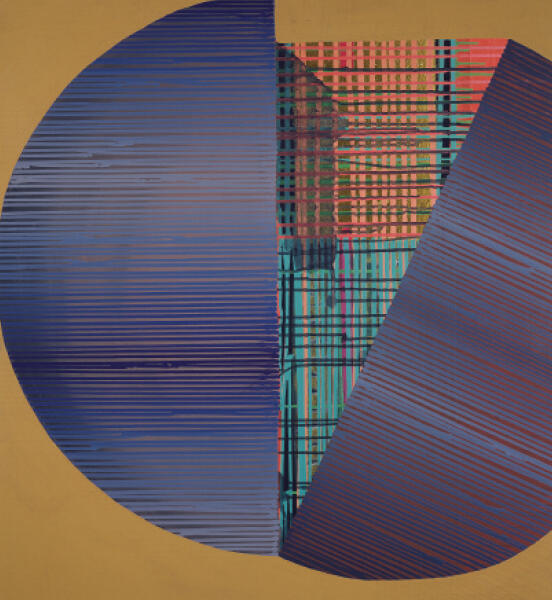
In Paris, he gradually synthesized these personal experiences. If his earliest stage had developed between the ascending line of the mountains of La Rioja and the endless horizon of the Argentine pampas, his experience in the East potentiated those vertical and horizontal forces present in the yin-yang symbolism, but also identified with the masculine-feminine principle, Heaven and Earth, passiveness and action. After a stage of symbolism, Torres Agüero began to develop abstract works in which he capitalized the spontaneous handling of liquid matter. Sometimes, the threads of dripping color wove thin meshes whose effect lies in their transparence, and in other cases, the monochrome or multicolored lines generated dense wefts which appeal to the tactile through their thickness and texture. However, towards the end of the decade, the mastery over this modality of dripping gave way to a type of composition structured in geometric spaces in which straight lines prevailed.
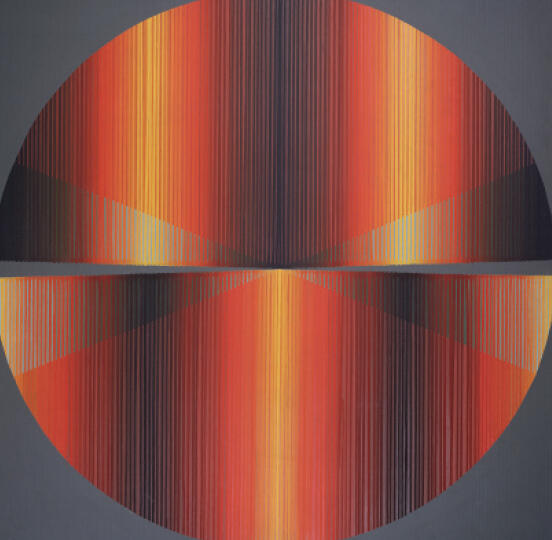
Although the straight line became the main resource of his artistic vocabulary, the artist’s straight lines were never hard-edged but had a sensible quality. Rather than drawing straight lines in the strict sense, he proposed straight lines that admitted the different thicknesses of the soft edges, obtained through the dripping of a liquid paint that glided on the canvas following the law of gravity. In that gesture, which was pondered and spontaneous at the same time, he had found the echo of his own sensibility. This was, in fact, the same concept he had conveyed to his students when he had taught them to draw with goose quill pens: they could apply more or less pressure in order to obtain the line thickness more in tune with their personality.
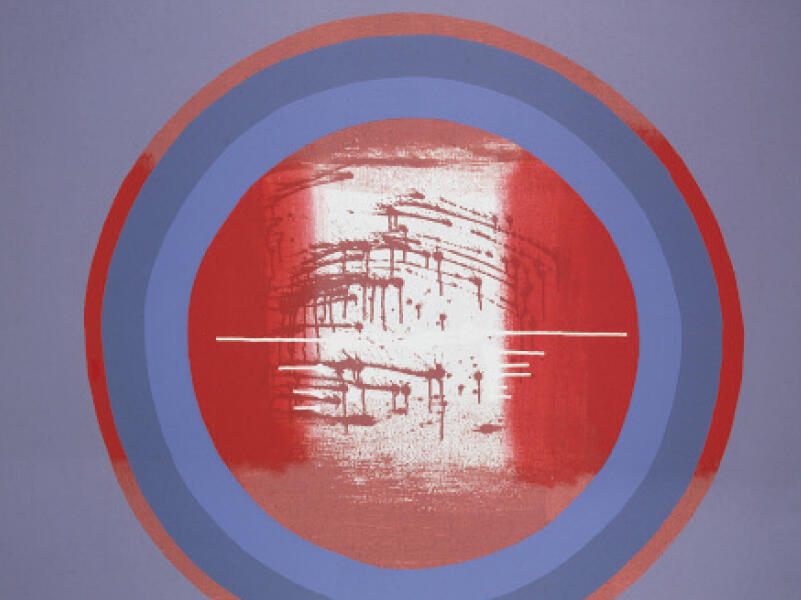
His concentric configurations, the recurrence of the circle inscribed within a square, and the balance and power of axial symmetry began to appear in Paris. His interest in the vibration of color and the clash of lights and shadows promoted the foundation of the Groupe Position which, in the framework of the developments of Kinetic Art and the experiences involving Op Art, connected him to Hugo Demarco, Armando Durante, Horacio García Rossi and Antonio Asís. In spite of its brief duration − this group was created in April, 1971, and was dissolved at the end of 1972 − the artists managed to show their works in the cities of Brussels, Paris, Brescia, Madrid, Seville, Bilbao, Bergamo and Zurich.
In the production of the past two decades, his paintings were based on a space built through successive layers that thrust the composition forward or make it recede, screens through which the viewer’s gaze penetrates in depth. Even before his untimely death − in 1995 − Leo was experimenting with textures for the backgrounds of the large-scale compositions. Inscribed within the simple forms of geometry, these regular wefts produced a sensitive, always emotional geometry.
But the optical play in this painting rests upon the color vibrations. The palette is often handled through subtle but systematic color scales, calibrated by an undoubted connoisseur of the methodical practice that any improvisation paradoxically requires. Occasionally, on the other hand, a strong color emphasis suddenly disrupts the serenity of the surface. In any case, Torres Agüero was a consummate master in the art of dosing chromatic effects in order to produce the changes in rhythm that would dynamize the reading and that − just like in jazz − work on the basis of acceleration and pause. In music as in painting, therefore, by achieving control over the sequence sound-silence-vibration, as he himself wrote, the spirit becomes a butterfly in the wind.
.....................................................
*Buenos Aires, January 2012